
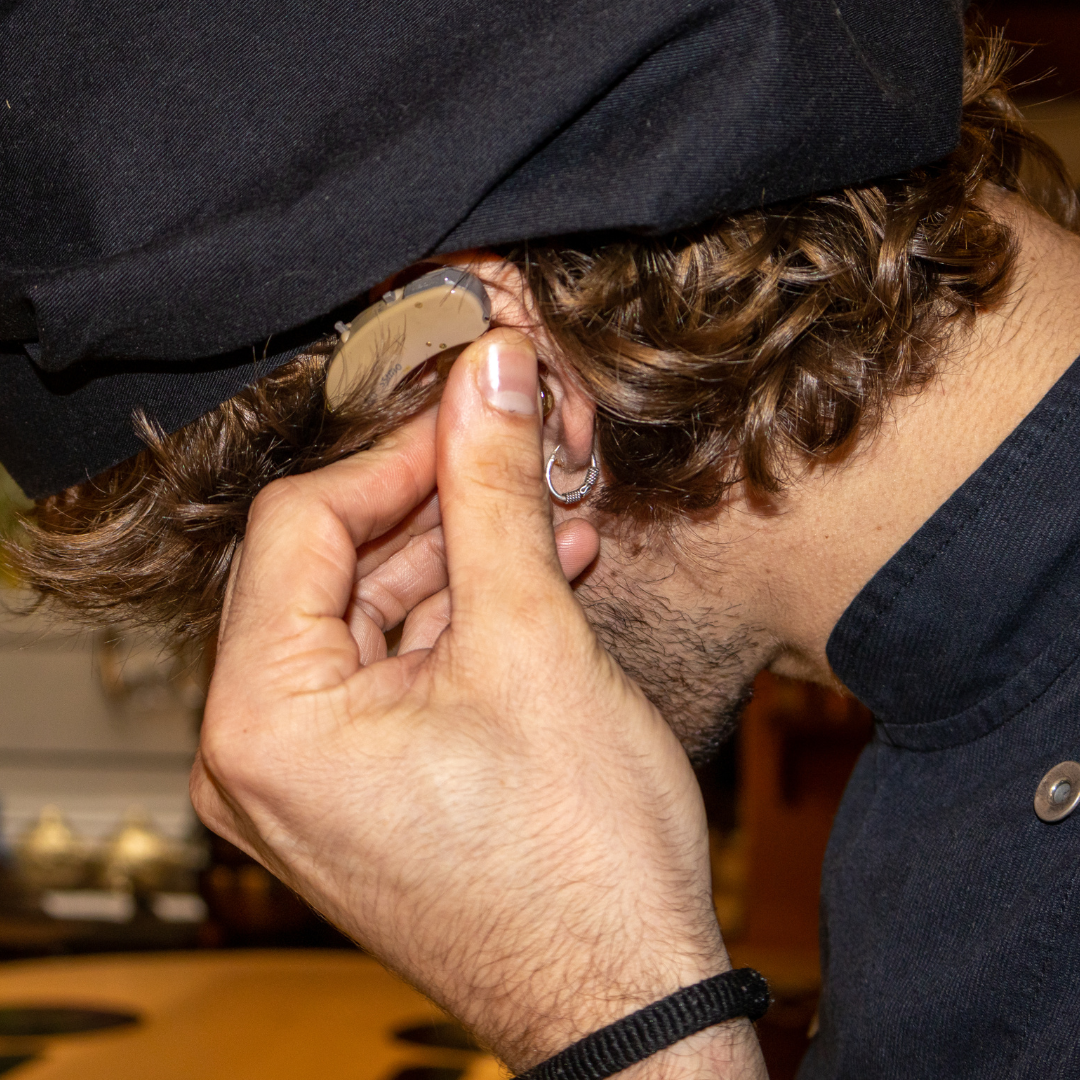
Group discussions in restaurants often become difficult to comprehend when room acoustics compete with your focus and hearing. Our audiology clinic conducts specialized testing to evaluate hearing in both quiet sound booths and noisy simulations to isolate the underlying cause. After uncovering the precise factors driving your difficult hearing, our team helps you select individualized auditory solutions.
How Can Hearing Seem Normal at Home but Fail in a Restaurant?
Quiet rooms provide a favorable signal-to-noise ratio, meaning a speaker’s voice is much clearer than the sounds around it. Dining venues establish an entirely contrary auditory challenge. Multiple voices, music, kitchen noise, and reverberation overlap with speech, forcing the ears and brain to work harder to separate the person you want to hear.
Such difficulty frequently signals sensorineural high-frequency hearing loss, auditory processing dysfunction, or noise-induced cochlear damage. Dim lighting, physical tiredness, conversational distance, and divided attention exacerbate these listening deficits. Some people have normal results on a basic hearing test but still perform poorly on speech-in-noise testing. Experiencing speech-recognition struggles in noisy dining venues warrants a formal audiological evaluation regardless of seemingly normal quiet hearing.
Diagnosing High-Frequency Hearing Loss and Clarity Issues
We begin with a history of the situations that cause trouble, along with questions about noise exposure, tinnitus, medications, family history, and changes in either ear.
Diagnostic pure-tone audiometry establishes the softest auditory thresholds you can perceive across standardized frequencies via air and bone conduction pathways. A clinical presentation of high-frequency loss produces a downward-sloping audiogram where auditory thresholds worsen significantly at higher frequencies. Additional testing may include tympanometry to assess middle-ear function and word-recognition testing to measure speech understanding.
Since sound-treated booths cannot replicate the chaos of a crowded dining room, speech-in-noise testing provides critical real-world insight. The test assesses word and sentence discrimination as background acoustic competition intensifies. Together, these results show whether the problem involves audibility, speech clarity, background-noise processing, or a combination of factors.
Auditory Processing Disorders: Impact on Adult Communication
An auditory processing disorder affects how the central auditory nervous system interprets sound. While peripheral ears may register soft tones normally, the auditory cortex struggles to filter competing noise, resolve phonetic contrasts, or keep pace with rapid conversation. We prioritize assessing peripheral auditory acuity before recommending an in-depth central auditory-processing assessment or external medical referrals.
Actionable Listening Tips for Noisy Social Settings
Simple situational adjustments enhance the speech signal entering your ears and offer clearer facial cues. Prior to dining, choose venues known for lower noise levels or schedule meals during quieter dining hours. Restaurants featuring plush booths, wall acoustic panels, heavy drapery, carpeting, and sound-dampening materials provide superior listening compared to open rooms with reflective surfaces.
When arriving at the dining venue:
- Ask host staff for a quiet table distanced from kitchen traffic, bar noise, audio speakers, and loud group tables.
- Position your chair against a perimeter wall to diminish competing auditory chatter behind your head.
- Position yourself directly opposite your companions where direct lighting highlights their facial expressions.
- Sit as close to the speaker as comfort permits to preserve speech volume and clarity.
- Place your better-hearing ear toward the person you most want to hear.
- Request that companions rephrase misunderstandings using different words rather than repeating the same sentence.
- Validate significant pieces of information directly rather than feigning understanding during dialogue.
- Take brief listening rests outside or in quiet hallways when mental fatigue emerges.
- Ask companions to speak clearly at a natural pace.
- Elevated yelling distorts auditory signals and seldom improves actual phonetic comprehension.
What Are the Best Tools for Hearing with Background Noise?
Optimal technological solutions depend entirely on the etiology of your symptoms, target acoustic spaces, and whether measurable hearing loss exists. Customized hearing aids employ directional microphone beamforming, noise cancellation algorithms, and targeted dining programs to prioritize speakers in front while lowering ambient noise. Users should establish realistic expectations because no hearing device can fully eradicate all unwanted ambient speech.
Remote wireless microphones offer an exceptional boost to the signal-to-noise ratio in challenging venues. The remote unit is attached to the speaker’s clothing or placed nearby, transmitting that voice straight into compatible hearing aids or an audio receiver. This strategy bypasses the detrimental effects of room reverberation, distance, and localized background chatter.
Other clinically valuable tools include:
- Dedicated table microphones engineered to capture small-group dialogue
- Telecoil components connecting directly to public hearing-loop systems
- Real-time smartphone speech-to-text transcription and live-captioning apps
- Earbuds or hearables with compatible assistive-listening features
- Sound-level or restaurant-review tools for finding quieter locations
Our audiology staff helps you evaluate options, ensures wireless compatibility, and trains you on operating your chosen equipment.
How an Audiologist or Physician Can Improve Hearing in Noise
Undergoing a formal hearing evaluation takes your care beyond the limited baseline of hearing adequately in quiet spaces. We assess the specific acoustic settings, speaker dynamics, and volume levels that disrupt your hearing to administer targeted evaluations. The assessment may include pure-tone thresholds, middle-ear testing, word recognition, and speech-in-noise measures. Specialized auditory-processing testing can be ordered when patient history and preliminary audiometric findings warrant deeper neural investigation.
Any sudden, asymmetric, or rapidly deteriorating hearing loss demands immediate medical evaluation by an ear, nose, and throat physician. Dedicated individualized care pinpoints the underlying auditory cause rather than dismissing your struggles as standard restaurant noise.
Book Your Comprehensive Hearing Evaluation Now
If noisy restaurant gatherings leave you struggling to follow dialogue, pulling away, or feeling completely drained, schedule an audiological evaluation with our team. Our specialists can introduce effective interventions to support your hearing in noisy environments via precision hearing aid fittings, assistive devices, or audiological rehabilitation.
Contact our audiology office today to schedule your evaluation and move toward effortless, confident conversations.